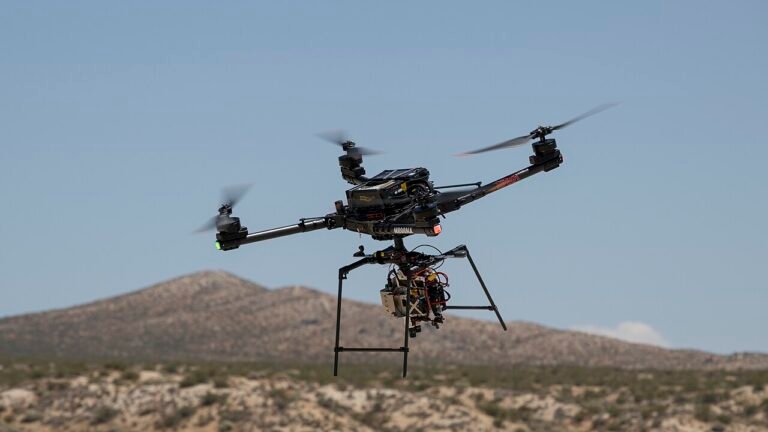

NASA has shown its newest experimental aircraft, the X-70 Fractal, at the UP.Summit held at the Kennedy Space Center in Florida. The reveal took place on a Wednesday, according to a NASA news release dated 5 November 2026. The agency presents the aircraft as a flexible research platform meant to speed up the testing of new flight technology.
Experimental aircraft are built to try out ideas that have not yet been proven in the air. The X-70 is designed to be reused across many studies rather than serving a single purpose, which is why NASA stresses how easily it can be adapted.
Also read: NASA tests drone navigation system for safer planetary landings
Built to test flight controls
The X-70 is crewed, meaning a person flies it, and NASA says its flight-control system can be reconfigured rapidly. That should let researchers examine how an aircraft can change direction and move in ways the agency says have not been shown before in crewed flight. Testing these systems with a pilot on board is intended to show how they behave in real conditions rather than only in simulation.
The aircraft can also carry experimental equipment. NASA says it can hold up to 2,000 pounds of test equipment, both inside the aircraft and attached outside it. Because the payloads can be swapped, the agency expects its teams to move from one experiment to the next without long delays.
Performance figures
NASA lists several design figures. With a takeoff weight of 10,000 pounds, the X-70 has a planned cruising speed of Mach .75, a speed measured against the speed of sound. It can climb to altitudes of up to 45,000 feet.
Its operating range is listed as beyond roughly 1,726 miles, which NASA also gives as 1,500 nautical miles. NASA says these numbers will allow the aircraft to take part in challenging research across many different conditions.
Where the X-70 fits in NASA’s history
NASA describes the X-70 as the latest in a long line of X-planes, experimental aircraft that have helped shape flight. The Bell X-1 is the first example it names, having broken the sound barrier in 1947. Later examples include the X-15, a hypersonic research aircraft, and the X-59, a quiet supersonic demonstrator.
X-planes are generally used to answer specific questions. Once those answers are in, engineers can move on to the next set of questions. The X-70 adds a crewed platform that NASA can keep adapting, which the agency suggests will help it move faster between studies.
Laurie Grindle, who leads the Aeronautics Division at NASA, part of the Research and Technology Mission Directorate, notes that the agency has relied on X-planes for decades to develop aviation technology. She says the X-70 will help speed up aeronautics research.
What happens next
NASA Administrator Jared Isaacman, who leads the agency, presented the X-70 as one part of a broader shift in aeronautics. NASA expects the aircraft’s maiden flight as a NASA vehicle to happen within two years.
The release does not give the cost of the aircraft, which company or team built it, or a more exact flight date. Those details remain unclear, and the first flight is an agency expectation rather than a confirmed date.
Frequently asked questions
What is the X-70 Fractal?
It is a crewed experimental aircraft that NASA unveiled as a research platform for testing advanced aviation technologies in real flight.
How much can the X-70 carry?
NASA says it can hold up to 2,000 pounds of test equipment, both inside and outside the aircraft.
When will the X-70 first fly?
NASA expects the first flight to happen within two years, according to its release, though no exact date is given.
Why it matters
For most readers, the X-70 shows how public agencies test new aviation ideas before they are widely used. Experimental aircraft let engineers check flight-control systems and other technologies in real flight, not only on paper or in simulations. NASA says X-planes have helped it develop aviation technology for decades. Readers can watch whether the first flight happens within the period NASA has set out.
Sources
Share this article
This article was prepared with AI assistance from the sources listed above and published after automatic quality checks. Our editor reviews published articles and corrects mistakes. How we work.
Spotted a mistake? See how we correct errors.